
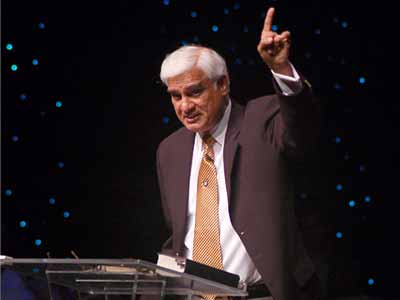
Ravi Zacharias
I have been talking with a friend recently who is asking questions about life. There are times in all our lives where we stop the treadmill and ask what this is all about. Is there more than just this daily routine?
I’m reminded of something that I first heard from Ravi Zacharias years ago. Ravi is a friend and one of my favorite Christian theologians. Ravi says that there are four pieces that make up a person’s world view. They are:
- Origin – How did I come into being?
- Meaning – What brings life meaning?
- Morality – How do I know right from wrong?
- Destiny – Where am I headed after I die?
Of course, people might answer those questions quite differently. But to have a coherent worldview, it should hold up to six important inquiries.
- The worldview must have a strong basis in correspondence to that which is factual.
- There needs to be a high degree of coherence. It should hold together without contradicting itself in areas.
- The worldview should have explanatory power. It should correspond to what we actually perceive, feel, and experience in life.
- The worldview should avoid two extremes, will not be too simplistic (ie. atheism) or too complicated (ie. pantheism.)
- The worldview should have more than one line of evidence.
- The worldview should have have the ability to explain the similarities and differences in other world views.
This is some heady stuff, but oh how important. I’m wondering how you might answer the questions of origin, meaning, morality, and destiny? Are those clear in your mind, or a bit muddy?
It is a good thing to explore this! In fact, it might be one of the most important endeavors of your life. I’m reminded of the writer of Proverbs;
Choose my instruction instead of silver,
knowledge rather than choice gold,
for wisdom is more precious than rubies,
and nothing you desire can compare with her.Proverbs 8:10


 Brian Boone