A Dark Path

Another shooting tragedy has befallen our nation.  This time among little first-graders which makes the situation all the more heart-breaking.  We are a befuddled nation.  Why is this happening?  How can we make it stop?  My sense is that there is no single strand that we can pull to bring the carpet back into order.  I wish there was an easy fix, but I think we all know that there is not.

A year ago, I completed a study in the book of Judges.  In this ancient Biblical literature, Israel had stepped into the Promised Land, but they began to unravel.  It was truly one of the darkest hours in Biblical history.  When you read stories from this era, remember that it is not proclaiming how things should be but rather how things are.  And thus we have stories like Gideon who begins with faltering faith and timidity but ends in a rampage ready to kill anyone in his path (Judges 7-8).   We have Samson who took a vow of purity and then began to dismantle every piece of it (Judges 13-15).

The story of Judges is about a people who have left their covenant of love with God.  They systematically leave God only to suffer under the tyranny of idolatry.  They cry out to God who hears them and restores them before the cycle is repeated again.  It happens over and over, but they never seem to learn.

But there is a dark descent in the book.  Things in the nation become increasingly chaotic.  Irrational behaviors that were thought impossible at the beginning of the book become commonplace by the end.  There is a sense of unity and rational thinking at the beginning.  For instance, the tribes work together in a war.  But by the end of the story, the nation is fractured.  All the tribes are warring against one another.  A form of anarchy seems to have taken over.  Make no mistake about the last few words of the book, “Everyone did what was right in his own eyes” (Judges 21:25).

I remember my mom telling me about the United States during WWII.  It was a nation unified.  People were pulling together.  It was an honor to have a victory garden or to sacrifice for the country.  There was actually a collective thinking about what was best for the country and not just an individual.  Those days seem so long ago.  I think it is hard for us to imagine this happening today.

I believe we are weaving a tapestry as a nation similar to that in Judges.  It is a culture in which “everyone does what is right in his own eyes.”  Increasingly there is no appeal to One higher.  We don’t need days of prayer and fasting, we just need moments of silence.  There are no desires to work together toward the good, there is just subterfuge and posturing waiting for the right time to help “our side” prevail.

I know that some rail upon prayer in schools as the linchpin of turning away from God.  I think it goes so much deeper.  We have systematically sought to be the “captains of our own ship” and God will let us do so, but to our own demise.  We are fast becoming a ship of fools but cannot recognize it.

Joseph Farah has touched on what I am saying, “We are reaping the seeds of the whirlwind we ourselves planted. … It’s not that there are too many guns in our hands. It’s that there is not enough repentance in our hearts.”   I might modify this slightly to say, “Not only are there too many guns in our hands, but with more far reaching and deadly consequences, there is so little repentance in our hearts.”

Our country faces so many divisions.  Whether the debate is budgets, guns, or gay rights, divisions are readily evident.  Perhaps we are ripe for an old fashioned awakening?  During a time of such darkness, God would visit us with a great light?  I cannot completely imagine what that might look like, but I would welcome it.  I think we all know that the current path is not a good one.  I pray for a collective return to One who can make order from chaos.

Why was Jesus baptized?

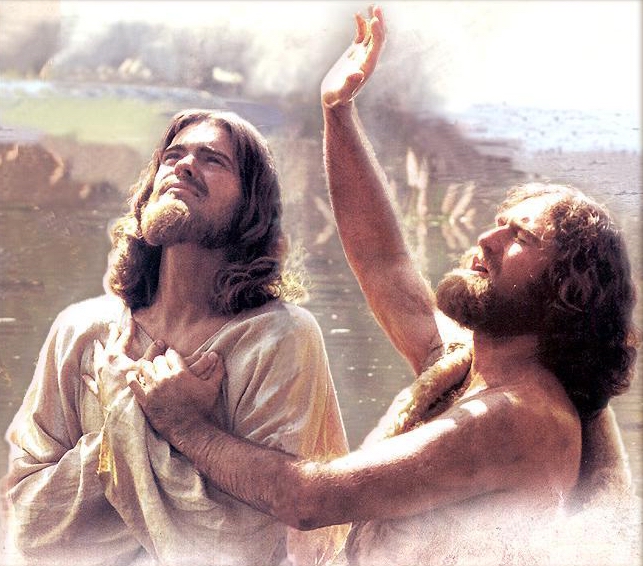
In the Gospels we are told that Jesus came to John the Baptist who was baptizing people in the Jordan River.  John was paving the way for the coming Messiah.  He was baptizing people calling them to repent from their sins.  His baptism was preparing them for the greater baptism with the Holy Spirit and fire, brought by Jesus.

Matthew 3:11-15

11 “I baptize you with water for repentance. But after me will come one who is more powerful than I, whose sandals I am not fit to carry. He will baptize you with the Holy Spirit and with fire. 12 His winnowing fork is in his hand, and he will clear his threshing floor, gathering his wheat into the barn and burning up the chaff with unquenchable fire.”

13 Then Jesus came from Galilee to the Jordan to be baptized by John. 14 But John tried to deter him, saying, “I need to be baptized by you, and do you come to me?”

15 Jesus replied, “Let it be so now; it is proper for us to do this to fulfill all righteousness.” Then John consented.

So why did John baptize Jesus?  He knew that Jesus was the sinless one, the perfect lamb (John 1:29).  This is why John was reluctant to baptize Jesus and even balked at doing it!  But Jesus said that it was proper to fulfill all righteousness.

There have been several theories over the years about why Jesus asked John to baptize him.  I am grateful to John MacArthur for the excellent summary of the five positions.  MacArthur places the one he subscribes to last.

“Some interpreters suggest that He intended His baptism to be a sort of initiatory rite for His high priesthood, reflecting the ceremony which prepared the Old Testament priests for their ministry. Others suggest that Jesus wanted to identify Himself with the Gentiles, who were initiated into Judaism as proselytes by the act of baptism. Still others take Jesus’ baptism to be His recognition and endorsement of John’s authority, His accrediting of John as a true prophet of God and the genuine forerunner of His own ministry. A fourth view is that the Lord intended to be baptized vicariously for the sins of mankind, making His baptism, along with His atoning death on the cross, a part of His sin-bearing, redemptive work.

But none of those views is supported by Scripture, and none fits the context of the present passage. 

Permit it at this time was an idiom meaning that the act of His baptism, though not seemingly appropriate, was indeed appropriate for this special time. Jesus understood John’s reluctance and knew that it came from deep spiritual commitment and sincerity. He gave permission for John to do what, without divine instruction, he would never have been willing to do. He assured the prophet that in this way it is fitting, and went on to explain to John that His baptism was important for both of their ministries, for us to fulfill all righteousness. For God’s plan to be perfectly fulfilled, it was necessary for Jesus to be baptized and to be baptized specifically by John.

It seems that one reason Jesus submitted to baptism was to give an example of obedience to His followers.”   John MacArthur, Why was Jesus Baptized, 2011.

I would not vehemently argue against any of the positions.  But at a minimum, Jesus was tying his coming baptism of the Spirit to John’s baptism calling for repentance from sin.  And Jesus obediently entered the waters Himself, not because He needed repentance himself, but because he modeled what we needed.


Who Were the Twelve Disciples

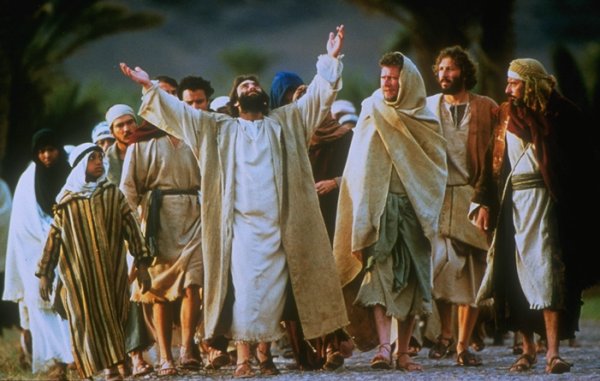
I love the question I saw recently, “Your children know the names of the Seven Dwarfs… How about the Twelve Disciples?”  I must admit that even as a pastor, the twelve names don’t just flow off my tongue.  Certain disciples are hard to miss.  Come on, most know about Peter.  His brash sayings always fill the room!  Matthew is also hard to overlook as the tax-collector and author of one of the gospels.

But what about Nathanael or Philip.  They seem like more forgotten apostles.
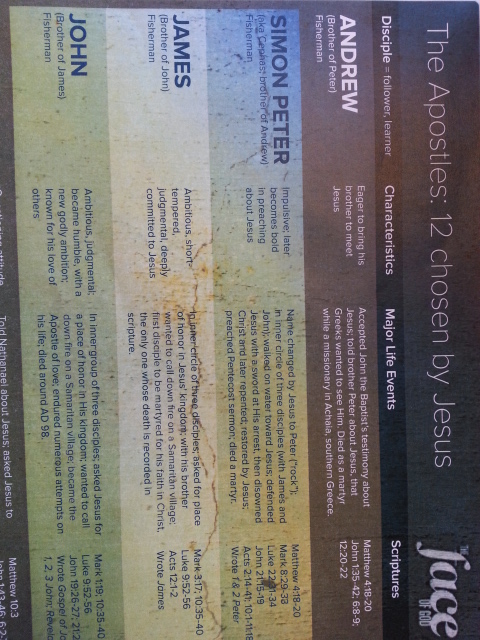
Oh, and what about the terms “disciple” and “apostle”?  Disciple simply means “learner or follower.”  There were certainly many disciples that followed Jesus beyond just “The Twelve.”  They were at various levels of understanding the true nature of Jesus (John 6).  Apostle means “sent one.”  And so this term picks up frequency in the church after Jesus’ death as apostles are sent into the world to proclaim the new about Jesus.

For those that would like a quick snapshot about the twelve disciples of Jesus, I recently ran across this neat chart.  It was created by Jeff Patterson and Willamette Church.  It gives a great overview of each disciple.

My big takeaway.  Whether I know their names or not, I admire what God did with them.  These were a collection of ordinary men whom God captured (in a good way) and used for divine purposes.  Most died heinous deaths, but they would not have traded knowing Jesus even though experiencing such adversity.


Online Learning Portals Emerge

The world of learning is changing.  In recent years, top schools like Stanford, U Penn, U Washington, Caltech, and many others have been hosting classes online for FREE.  Yup, for free, nada.

What would lead institutions to do something so reckless?  Why give away the cookies?  In many instances, it is a good-will gesture.  But it does not hurt to also have the reputation to be first in global learning!

But the real amazing result is that thousands are taking the courses.  In a recent Stanford class on artificial intelligence, 160 thousands students enrolled for the course.  Yes, that’s right!  I’m taking an online course right now in the “History of the World Since 1300” that has 70,000 students.  This course is offered by Princeton.

So how do you find these classes?  Increasingly schools are developing portals in conjunction with each other.  Two of the most popular are coursera.org and udacity.com.  Both are easy to navigate and it is a piece of cake to register.

But remember, there are no grades here.  This is not the place to gain diplomas.  It is the place to go simply to learn.  But apparently thousands around the world like that idea!

So, now I turn a small corner.  I’m envisioning the day when similar classes will be offered from the best evangelical seminaries in the world.  Imagine taking an overview of the Old Testament from professor Bruce Waltke from Reformed Seminary,  or a tour of the Gospels with Craig Blomberg from Denver Seminary.

This kind of learning environment could become a vital element of education for the local church.  I do not believe it will ever replace live teaching and face-to-face learning.  Yet it could be a fantastic tool to augment ongoing discipleship.

This is an exciting new world.  I encourage my friends to take one of these classes at Coursera or Udacity.  Oh, and don’t forget the online school called Khan Academy that is also a leader in this emerging area.  Khan was recently given $1.5 million from the Gates Foundation to expand the model!


“The Bridge”

Today at church, I spoke about Abraham’s “almost sacrifice” of Isaac.  Of course, we know that a substitute would be provided, the ram in the thicket.  But Abraham did  not know this when he obeyed God.

My point today was that the God of the Bible does test.  And there are certain things that testing reveals.  For instance, it reveals the source of our reliance and the depth or maturity of our faith.  And God always has the perfect ability to challenge the things that emerge to be “god” to us.

The other big part of the passage is that testing revealed to Abraham that God is the one who “sees.”  He names the place on Mount Moriah, Yahweh Yi’Reh, meaning “the God who sees to it”, or “the God who provides.”  So the testing revealed as much to Abraham as it did to God.

I closed the service today with this video.  It is from a Chech film shot in 2003.  The film in Czech was titled “Most.”  But it was retitled in the US as “The Bridge.”

Remember before watching that for the Heavenly Father, there was no substitute.   He watched as His son was taken for the sins of the world.

Here’s the embed of the 4 minute short that I showed today.


No Junk DNA

The Psalmist forcefully declares, “I praise you because I am fearfully and wonderfully made; your works are wonderful,  I know that full well.”
Psalm 139:14

As someone once said, “God don’t make junk!”  And new scientific research is now confirming this.

For years, scientists believed that some of the human DNA was less valuable.  It was declared “junk DNA” because it did not seem to have the same importance as the other more critical pieces of the genetic matter.  But scientists are doing an about face.  “Indeed, the vast majority of human DNA seems to be involved in maintaining individuals’ well being — a view radically at odds with what biologists have thought for the past three decades,” stated the New York Post (September 5, 2012, “Junk DNA”)

The article went on to say, “Most of a person’s genetic risk for common diseases such as diabetes, asthma and hardening of the arteries appears to lie in the shadowy part of the human genome once disparaged as “junk DNA.”

My daughter is studying to be a nurse.  One of her favorite classes in the last few years has been human anatomy.  She comes home with fascinating stories about the importance of everything from human skin to eye-balls formed in utero.

The human body is one of the clear and ever-present signs that a maker is about a grand design. With each step that we go deeper, we find more “design,” and more to marvel over.


Drawing a Map of Israel

Learn how to draw a map of Israel.  This is especially valuable for students of the Bible as they locate geographic regions, mountains, rivers, and cities.  I’m motivated to learn this since I am headed to Israel next April (www.ccfinisrael.com).

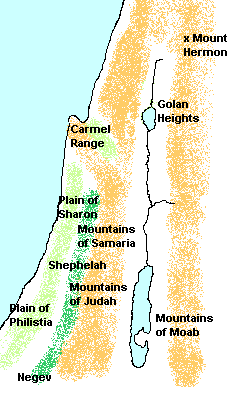
I recently discovered two different websites which teach easy methods for drawing simple maps of the country.  The first is called wikihow  (www.wikihow.com/Draw-Israel).  This map of Israel has all the main outlines and geographic details, but it features modern Israel with the regions and cities.  Ever wonder where the Gaza Strip or West Bank is located?  This map will help you.

The second map features the same outline (obviously) but it highlights more topography and more of the ancient aspect of Israel.  Find it at http://www.drshirley.org/geog/map01.html. For instance, you will locate ancient cities like Nazareth, Bethlehem, Bethel, Capernaum, and Jericho.  The second is especially valuable for Bible students.

So give it a try.  It is a pretty cool set of tools.


Pitfalls of the “Connected Life”

I recently saw this article from Sherry Turkle,  professor at MIT.

We expect more from technology and less from one another and seem increasingly drawn to technologies that provide the illusion of companionship without the demands of relationship.  Always-on/always-on-you devices provide three powerful fantasies:

  •   that we will always be heard;
  •   that we can put our attention wherever we want it to be;
  •   and that we never have to be alone.

Indeed our new devices have turned being alone into a problem that can be solved.

When people area alone, even for a few moments, they fidget and reach for a device.  Here connection works like a symptom, not a cure, and our constant, reflexive impulse to connect shapes a new way of being.

Think of it as “I share, therefore I am.”  We use technology to define ourselves by sharing our thoughts and feelings as we’re having them.  We used to think, “I have a feeling; I want to make a call.”  Now our impulse is, “I want to have a feeling; I need to send a text.”

So, in order to feel more, and to feel more like ourselves, we connect.  But in our rush to connect, we flee from solitude, our ability to be separate and gather ourselves.  Lacking the capacity for solitude, we turn in to other people but don’t experience them as they are.  It is as though we use them, need them as spare parts to support our increasingly fragile selves.

We think constant connection will make us feel less lonely.  The opposite is true.  If we are unable to be alone, we are far more likely to be lonely.  If we don’t teach our children to be alone, they will know only to be lonely.

Sherry Turkle, psychologist and professor at MIT
NYTimes Sunday Review,April 22, 2012)

For as many benefits that the “connected life” brings to us, there are certainly also pitfalls.  Like most technology, we should ask what it means to use it rather than be owned by it.


You Called

Leighton Ford

A friend and mentor of mine, Leighton Ford, recently wrote this powerful poem.  I have known Leighton through several decades now.  I was originally introduced to him through a scholarship I received that was in the memory of his late son, Sandy Ford.  This led the way to a three-year period where I spent time with Leighton through the Arrow Leadership Program.  All of these experiences were very pivotal to God’s development of my life and character.  I’m quite grateful to God for Leighton.

Here’s his poem about the call of God.

You Called

You called,
Your calling was powerful,
and everything came together.

You called and a universe was born.
You called a man and a woman and a race was born.
You called an old man and old woman and a nation was born.
You called heathen king Cyrus and a people was re-born.
You called a virgin and a Savior was born.
You called some ordinary fishermen and an order was born.
You called a friend from death and a second life was born.
You called life from the tomb, and resurrection was born
You called an enemy and an apostle was born.
You called people from many races and a church was born.
You called me, and I was born a second time.

Where would we be without the voice of Your calling?
God knows … oh, of course, You know this old world could do with a new birth.

So please call again

Leighton Ford
June 28, 2012


Treasure Trove at Sno-Isle

I’m a big fan of local libraries.  I think they serve on important function in our society.  They give educational materials to all people regardless of class or income.  Let me give a big shout-out to my local Sno-Isle library system.  Find them at http://www.sno-isle.org.

I thought the library was totally cool when I discovered a few years back that you can check out digital books online.  And of course that only got better when they partnered with Amazon so that books can be read on the Kindle.  Come on, this is just too easy!

But their services went over the top (in a good way) for me last night when I went to the library.  I went to look at a copy of Consumer Reports.  On a whim, I decided to stop and talk to the librarian.  I asked casually if Sno-Isle has CR online.  To my surprise, yes.  And my price…. free!

So I pursued the conversation.  What else does the library have online for free.  I was blown away.  Try all of the Chilton’s auto repair manuals. Homework helps for kids. A career section.  A hospital comparison tool. And a thing called Mango Languages which helps you learn a new language.  All this for free!  Some of them are merely links to other spots on the internet, but many of the resources are paid subscriptions that the library offers to patrons for free.  For Snohmish residents, Consumer Reports is a $29 yearly value.

Try it out.  Look at the left drop-down menu for most of the free goodies.