
What’s with all the new names – Vine, Tumblr, Reddit? Is this some new urban dictionary? No… these are examples of new social platforms for digital citizens.
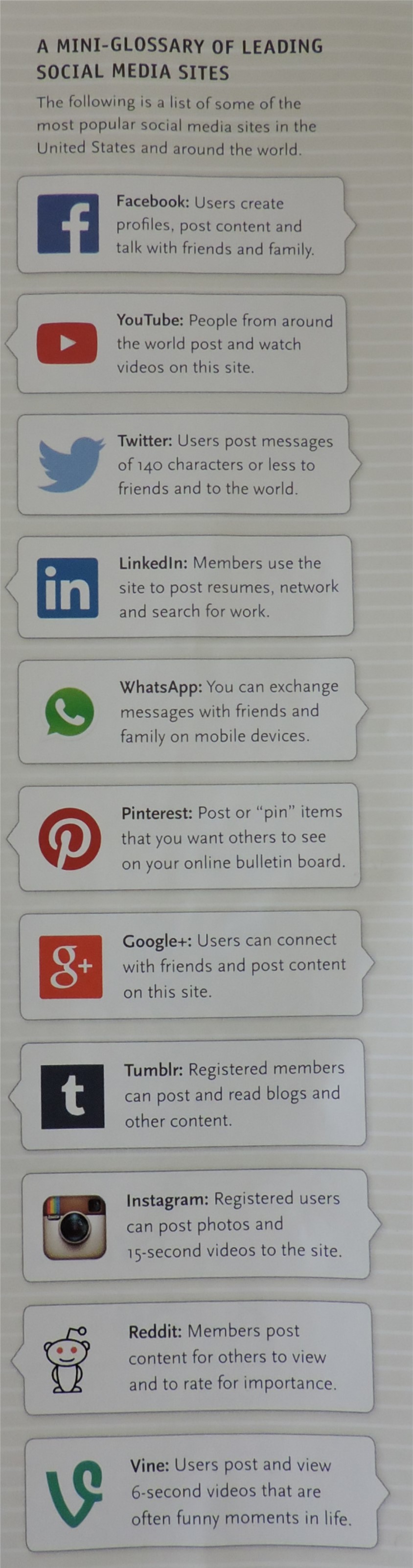 Chances are good that most of us have heard of facebook. It has become nearly a household name and older adults are the growing users of this platform. Yet on the other hand, many new social platforms are not as ubiquitous.
I saw this compilation of social platforms in a magazine on the airplane. I cut it out and digitized it. Forgive for forgetting to get the author’s name.
I’m betting many of us know YouTube. And those in business are pretty familiar with Linked-in.
I was even surprised recently to meet international students from Pakistan and Indonesia who were quite familiar with Facebook, Youtube and Twitter.
Do we really need all those social platforms? That’s a good question. But it helps to understand that each of them does something that is slightly different. In other words, everyone is not just building a new Facebook (although this is arguably what Google+ tried to do with very limited success).
In fact, let me help lots of people understand the basic difference between Facebook and Twitter. Facebook is a “closed” platform and twitter is an “open” one. Facebook has friends in a network. They are the only ones who see my posts. And I have to accept you into my friend network before you can see my information and posts.
Twitter on the other hand is open. This means that when I “tweet” anyone in the world can see what I have broadcast. That means I can become a follower of anyone on twitter. No friending. No asking.
There is a place for both. They both have different strengths and weaknesses.
I do not pretend to understand all of the platforms, and I’m not a user on all of them. But more and more platforms will emerge each with slightly different purposes. This does not mean that we must subscribe to all of them. But it is always valuable to have a sliver of understanding about why others do find upcoming platforms so valuable.
These platforms will increasingly become tools for communicating in the 21st century.


 Brian Boone
Leave a comment